Keyword Research 101: How to Find the Right Keywords (and How Revuin Makes It Easy)


If you only do one thing for your SEO strategy this year, make it keyword research. Every ranking, every click, and every piece of organic traffic your site will ever earn starts with a keyword someone typed into Google. Get the keyword wrong, and it doesn't matter how well-written your content is — nobody will ever find it. Get it right, and even an average article can pull in steady, compounding traffic for years.
In this guide, we'll break down what keyword research actually is, why it matters more than most marketers realize, the core metrics you need to understand, a practical step-by-step process you can follow today, and how to run the entire workflow inside Revuin — without juggling five different tools or paying for five different subscriptions.
What Is Keyword Research?
Keyword research is the process of discovering, analyzing, and prioritizing the exact words and phrases your target audience types into search engines when looking for information, products, or services related to your business. It's part linguistics, part data analysis, and part strategy — you're trying to reverse-engineer the language your customers actually use, rather than the language your internal team assumes they use.
That distinction matters more than it sounds. Companies frequently optimize for the terms they use internally (product names, industry jargon, feature names) instead of the terms real searchers use. A SaaS company might obsess over "workflow automation platform" while their actual customers are searching "how to automate repetitive tasks at work." Keyword research closes that gap with data instead of guesswork.
Why Keyword Research Still Matters in 2026
With AI Overviews, chat-based search, and zero-click results changing how people find information, some marketers have started to wonder if keyword research is still relevant. It is — arguably more than ever, for a few reasons:
Intent hasn't changed, only the interface has. Whether someone types a query into Google, asks an AI assistant, or uses voice search, they're still expressing an underlying need. Understanding the keywords behind that need tells you what to build content around.
Competition is smarter, not slower. Every competitor in your space has access to the same SEO tools you do. Ranking for a term today usually means out-researching, not just out-writing, whoever currently holds the spot.
Search volume still predicts demand. A keyword with real, consistent search volume is proof that people want an answer to that exact question — a level of market validation you rarely get for free anywhere else.
Content without keyword research is a guess. Publishing blog posts on "topics you think are interesting" instead of topics with measurable demand is one of the most common reasons content marketing budgets get cut.
The Core Metrics You Need to Understand
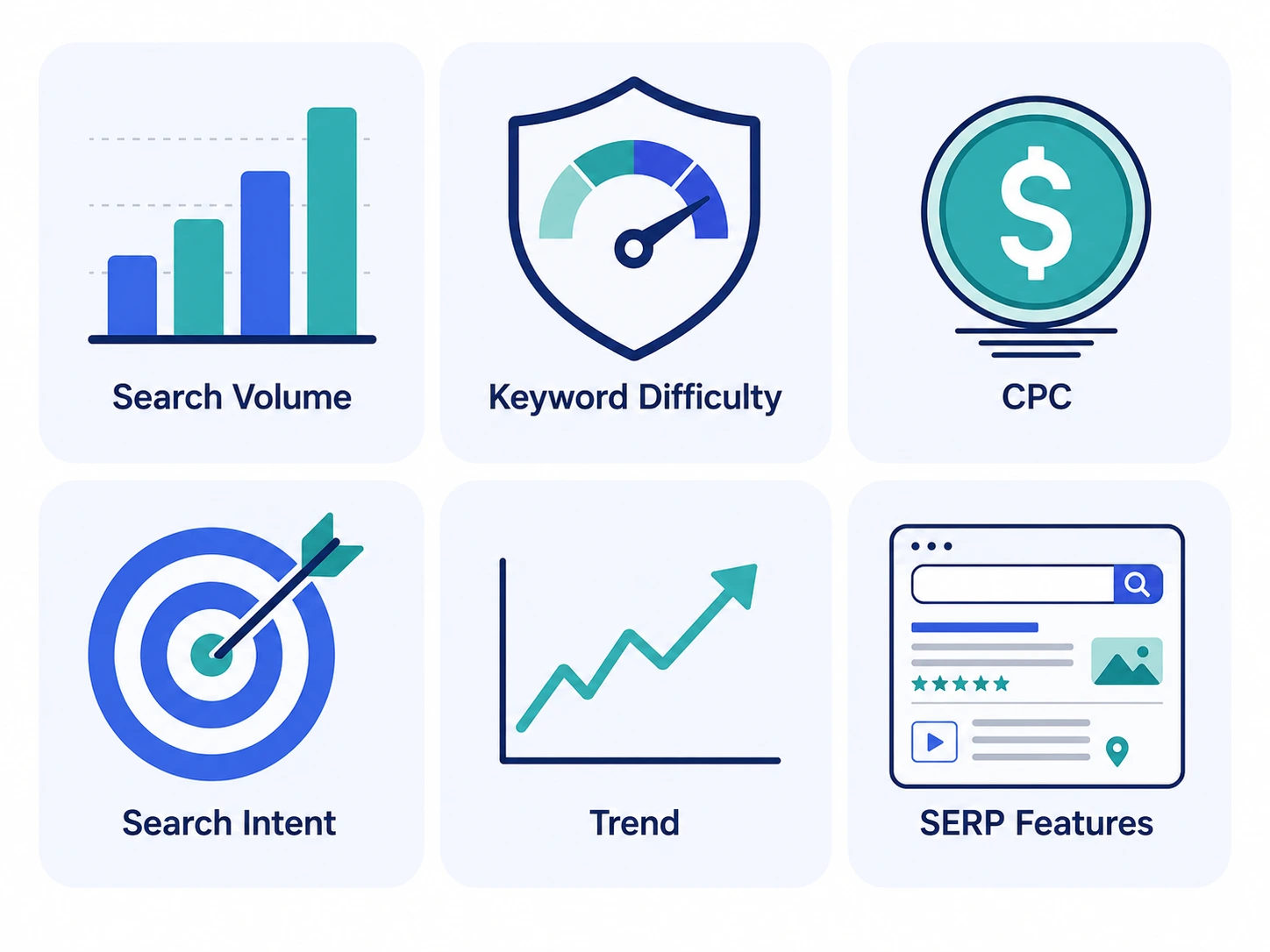
Before diving into a keyword tool, it helps to know what you're actually looking at. Every keyword research platform, Revuin included, surfaces some version of these numbers:
Search Volume — the average number of monthly searches for a term in a given location. This tells you the size of the opportunity, but not the whole story on its own.
Keyword Difficulty (KD) — a score estimating how hard it would be to rank on page one for that term, based on the authority and content quality of pages currently ranking there.
CPC (Cost Per Click) — what advertisers are paying per click in Google Ads for that term. High CPC is often a signal of strong commercial intent, even if you're not running ads.
Search Intent — whether the searcher wants information (informational), is comparing options (commercial), wants to buy (transactional), or is looking for a specific website (navigational).
Trend — whether interest in a keyword is rising, falling, or seasonal over the past 12+ months. A keyword with 5,000 monthly searches that's declining 20% year-over-year is a very different opportunity than one holding steady.
SERP Features — whether the results page includes featured snippets, "People Also Ask" boxes, image packs, or AI Overviews, all of which affect how much organic traffic is actually available to claim.
The mistake most beginners make is optimizing for volume alone. A high-volume, high-difficulty keyword that a brand-new site has no realistic shot at ranking for is a worse target than a lower-volume keyword you can actually win — and start compounding authority from.
A Practical, Step-by-Step Keyword Research Process
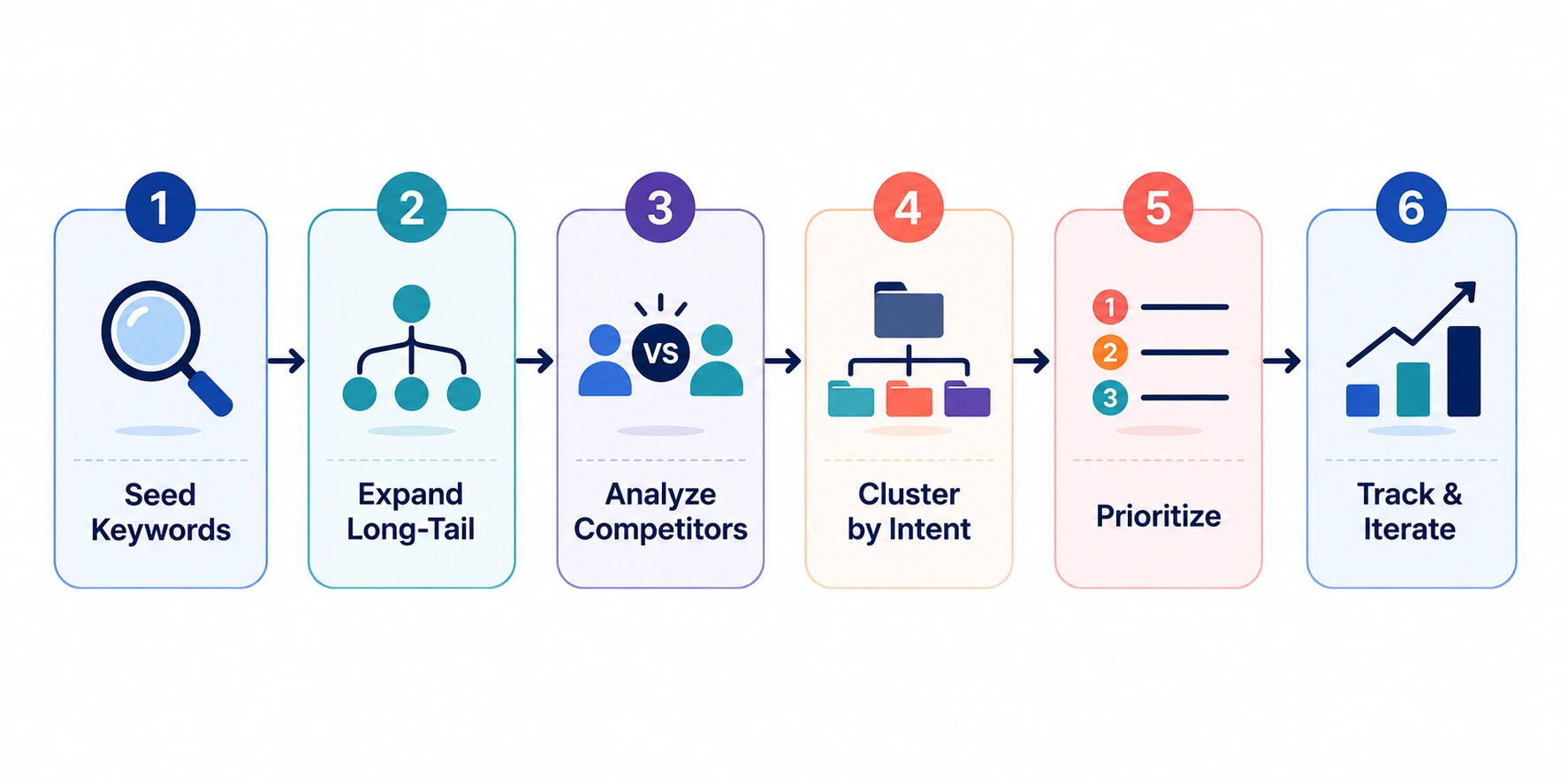
Step 1: Start With Seed Keywords
Begin with 5–10 broad terms that describe your product, service, or industry. If you run a project management tool, seeds might be "project management," "task tracking," or "team collaboration software." These aren't keywords you'll target directly — they're inputs to expand from.
Step 2: Expand Into Related and Long-Tail Keywords
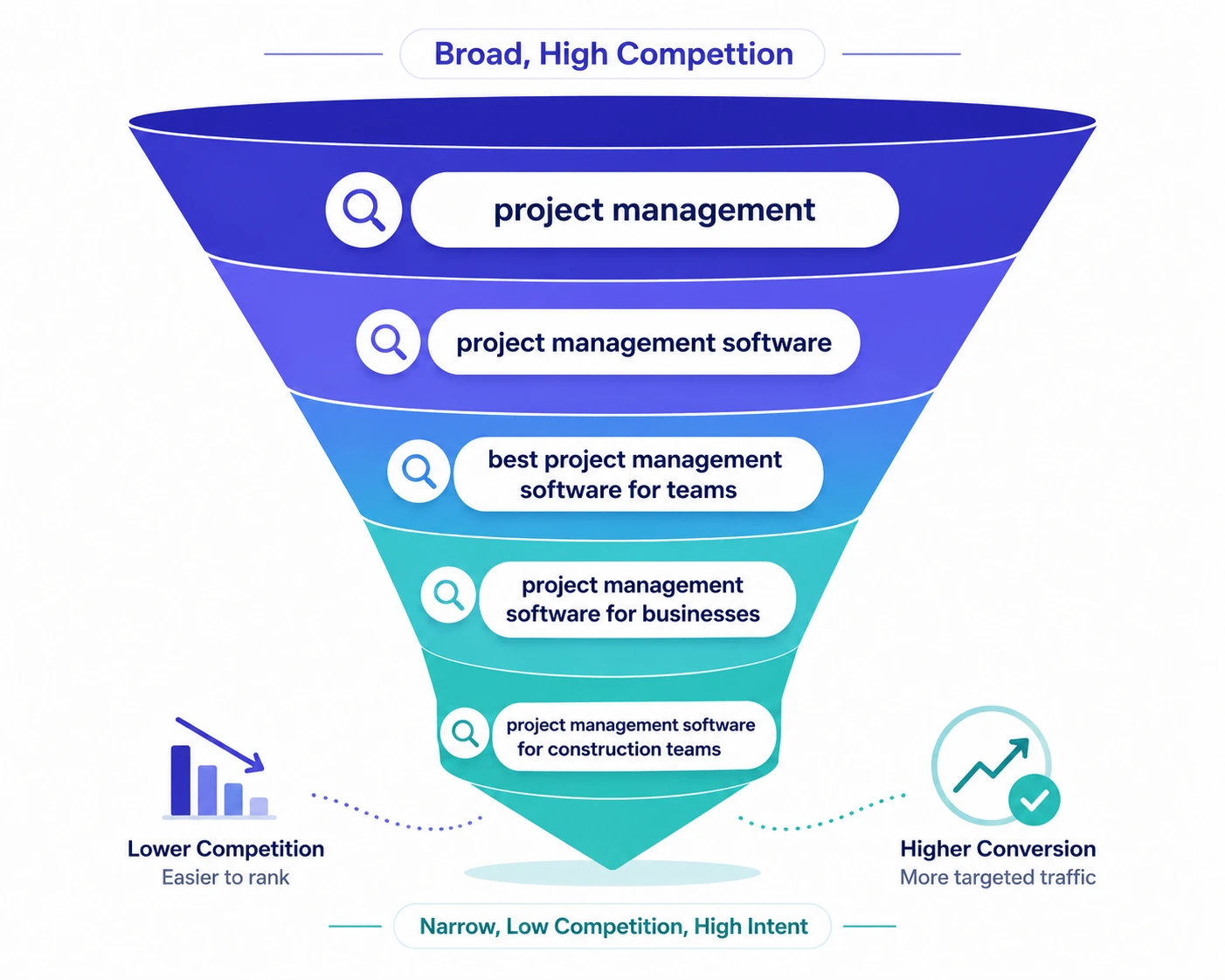
Your seed keywords will almost always be too competitive to target directly. The real opportunity lives in the long tail — longer, more specific phrases with lower volume individually but far higher conversion rates and lower competition collectively. "Project management" might get 50,000 searches a month and be dominated by Asana, Monday, and ClickUp. "Project management software for construction teams" gets a fraction of the volume but is winnable, and the searcher is far more qualified.
Step 3: Analyze Competitor Keywords
Instead of guessing what to write about, look at what's already working for competitors ranking in your space. If three competitors all rank for a keyword you don't currently target, that's a strong signal of unmet demand you can go after.
Step 4: Group Keywords by Intent and Topic (Clustering)
Rather than writing one article per keyword, group related keywords into topic clusters. A single well-structured article can realistically rank for dozens of closely related keyword variations if you cover the topic comprehensively, rather than spreading thin content across many near-duplicate pages.
Step 5: Prioritize by Opportunity, Not Just Volume
Weigh search volume against difficulty, trend direction, and business relevance. A mid-volume keyword trending upward with commercial intent and moderate difficulty will usually outperform a huge, saturated, informational-only term.
Step 6: Track Rankings and Iterate
Keyword research isn't a one-time exercise. Search behavior shifts, new competitors enter, and algorithms change. Ongoing tracking tells you what's working so you can double down, and what's slipping so you can refresh content before it loses its ranking entirely.
How to Do All of This Inside Revuin
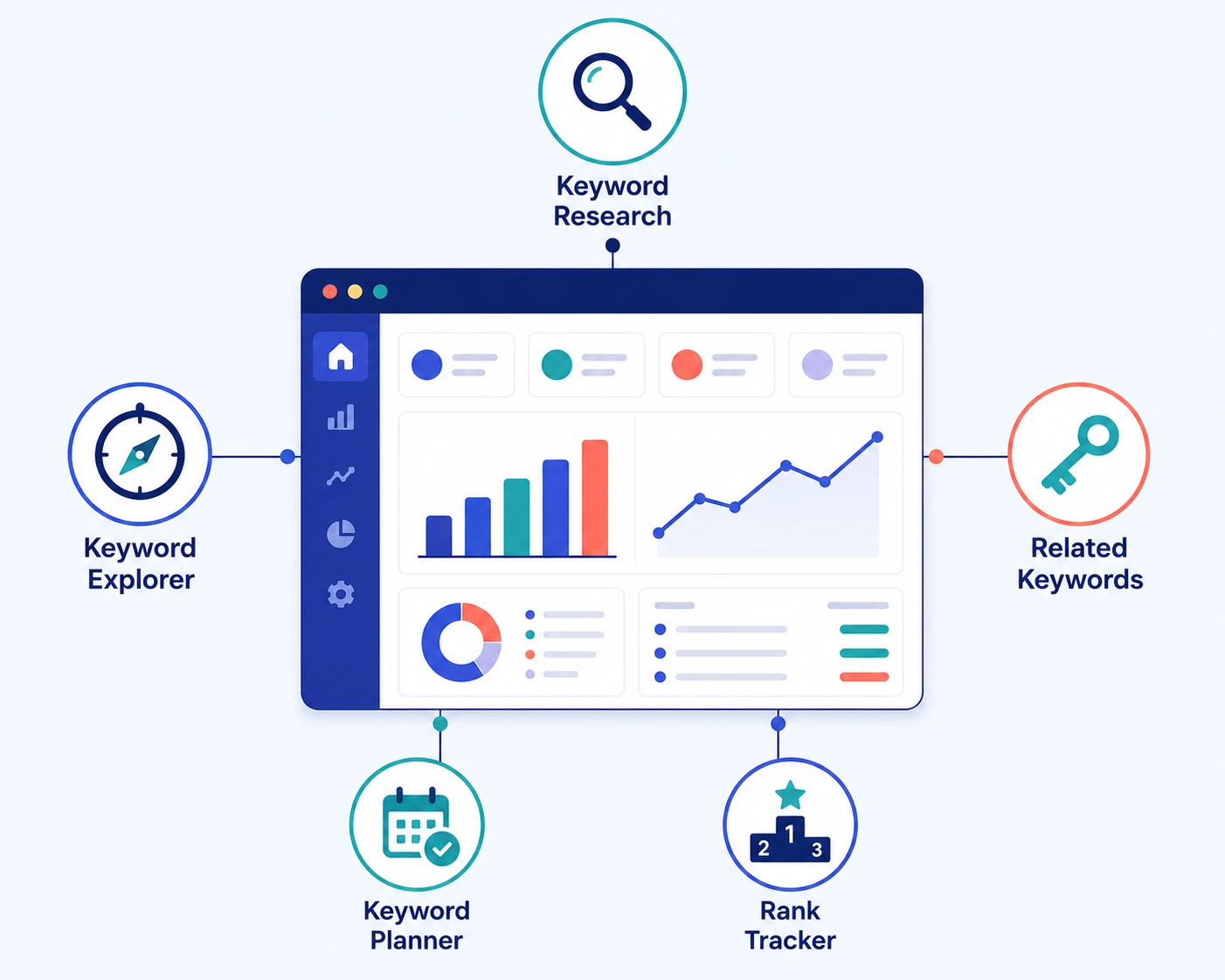
Revuin was built so you don't need to stitch together a keyword tool, a rank tracker, and a competitor analysis tool from three different vendors. Here's how each step above maps directly onto a Revuin feature:
Keyword Research Tool
This is your starting point for Steps 1 and 2. Enter any seed keyword and Revuin returns full keyword data — search volume, keyword difficulty, CPC, and competition — for thousands of related and long-tail variations in a single search. You can filter results by volume range, difficulty, word count, and search intent, switch between broad match, phrase match, and exact match views, and see a 12-month trend sparkline for every keyword so you're never targeting a term that's quietly dying. Results can be grouped into topic clusters automatically, which does the heavy lifting for Step 4 without any manual spreadsheet work.
Keyword Explorer
Keyword Explorer gives you two views in one tool: a full keyword overview (volume, difficulty, CPC, trend, and SERP features for a single term) and a "keywords for site" mode that reveals every keyword a specific domain — yours or a competitor's — already ranks for. This is the fastest way to execute Step 3, competitor keyword analysis, without manually guessing what a competitor might be targeting.
Related Keywords & Keyword Planner
Once you've found a promising seed, Related Keywords surfaces adjacent terms and questions real users are searching alongside it, helping you build out comprehensive topic clusters. Keyword Planner adds Google Ads-style bid range data on top, so even if you're not running paid campaigns, you get a read on commercial intent by seeing what advertisers are willing to pay for that traffic.
Global Search Volume
If you operate in multiple markets, Global Search Volume breaks down monthly search volume for a keyword country by country, instead of giving you a single blended global number. This matters enormously if you're prioritizing content for a UK audience versus a US one — the same keyword can behave completely differently by region.
Rank Tracker
Once you've published content around your prioritized keywords, Rank Tracker closes the loop from Step 6. Set up daily or weekly automatic rank checks for your target keywords and watch trend charts over time, so you know immediately if a page is climbing, plateauing, or slipping — instead of manually checking your rankings in an incognito browser tab every few days.
Domain Overview and Site Audit
For a broader view, Domain Overview shows you the full keyword footprint of any domain, including competitive positioning against similar sites, while Site Audit flags on-page and technical SEO issues that might be preventing your keyword-targeted content from ranking as well as its research would suggest it should.
Common Keyword Research Mistakes to Avoid
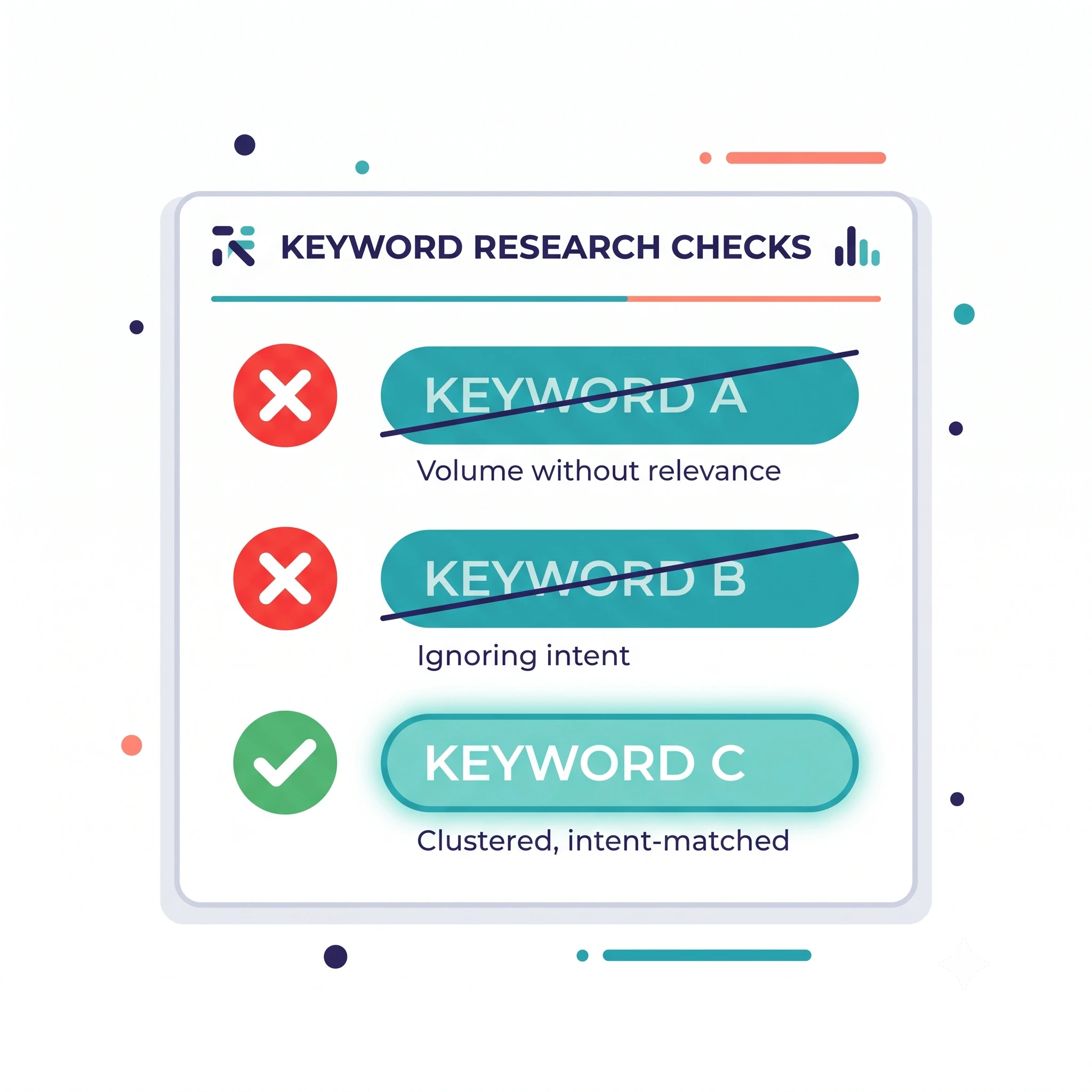
Chasing volume over relevance. A keyword with 100,000 searches a month is worthless if it doesn't match what your product actually solves.
Ignoring search intent. Ranking a product page for an informational query (or vice versa) leads to high bounce rates even if you do manage to rank.
Keyword cannibalization. Publishing multiple pages that all target the same or near-identical keyword splits your authority instead of concentrating it. Clustering keywords into single, comprehensive pages avoids this.
Treating it as a one-time task. Search trends shift constantly. Keywords that were golden opportunities 18 months ago may now be declining, saturated, or replaced by newer phrasing.
Skipping the trend and SERP feature data. Volume and difficulty alone don't tell you whether a featured snippet or AI Overview is about to eat most of the click-through rate for that term.
Getting Started
Keyword research is the foundation everything else in SEO is built on — content strategy, technical priorities, and even paid media decisions all get sharper when they're grounded in real search data instead of assumptions. The good news is you don't need a five-tool stack and five separate bills to do it properly.
Log in to Revuin, head to the Keyword Research tool, and start with a seed keyword from your industry. From there, Keyword Explorer, Related Keywords, Keyword Planner, and Rank Tracker are all one click away — the entire workflow from discovery to tracking lives in one place, using the same underlying data, so nothing gets lost translating between tools.